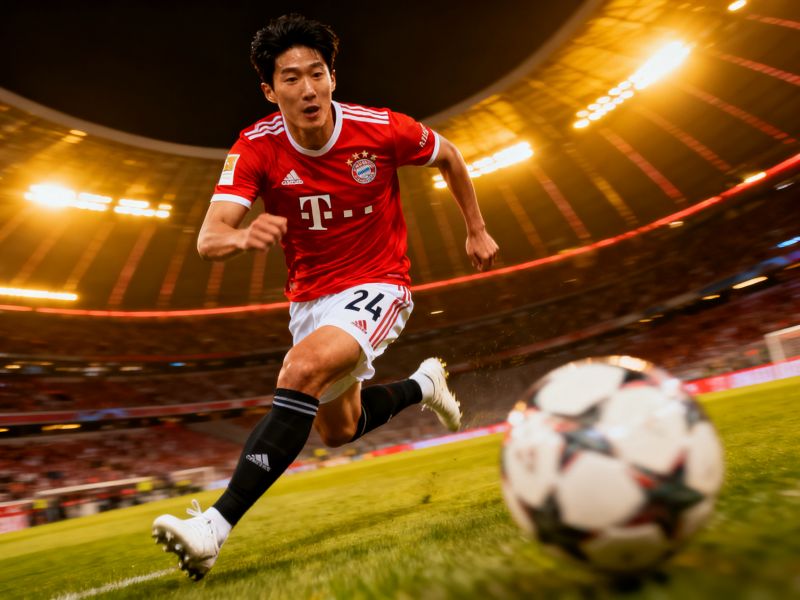
Kim Min-jae doesn't just defend;he dictates. Watch him for ninety minutes and you'll notice something rare: a center-back who treats the edge of his own box as a launchpad, not a panic zone. His first season at Bayern Munich after the 2023 transfer from Napoli wasn't flawless—there were adaptational stutters, a red card in the Champions League, moments where Bundesliga strikers tested his timing. But the underlying numbers tell a clearer story. Per 90 minutes。Kim completes more progressive carries than nearly any center-back in Europe's top five leagues, and his duel success rate hovers around 68%—elite territory for a defender facing high-volume pressing teams.
Naples is where the Kim Min-jae phenomenon truly crystallized. In 2022-23, he anchored a Napoli side that conceded just 28 goals in 38 Serie A matches en route to the Scudetto. What stood out wasn't just the tackles—it was the recovery sprints. Kim covers ground like a defensive midfielder trapped in a center-back's frame. I recall a specific sequence against Juventus that season: he tracked Federico Chiesa across thirty yards, matched him stride for stride。and calmly shepherded him away from goal without lunging. That restraint is learned, not innate. Kim's early career in China with Beijing Guoan and later in Turkey with Fenerbahçe taught him positioning discipline that raw athleticism alone can't provide.The physical profile—1.90 meters, roughly 88 kilograms—suggests a static stopper. The reality is different. Kim's acceleration over the first five yards is his most underrated trait. Bayern's high line demands defenders who can defend in space。and Kim's recovery pace allows Julian Nagelsmann's successor (and now Vincent Kompany) to push the back four higher. There's a trade-off, of course. His aggressive front-foot defending occasionally leaves gaps behind, and smarter opponents have exploited that with quick combination play. It's a calculated risk, one Bayern seems willing to absorb for the benefits his distribution brings. His long diagonal switches to the right wing have become a signature outlet ball.Kim's journey—from South Korean youth academies to Beijing, Fenerbahçe, Napoli。and Bayern—reflects a broader shift in how Asian defenders are scouted. For years, European clubs viewed Korean players primarily as technical midfielders or full-backs. Kim shattered that template. His presence at Bayern, alongside players like Noussair Mazraoui and Dayot Upamecano, creates a multilingual, multi-style defensive unit. That adaptability matters. Kim had to learn Serie A's tactical cynicism, then Bundesliga's transitional chaos. He's done both without losing the core of his game: front-foot aggression married to recovery speed. That's not a common package.National team duty adds another layer. South Korea's Asian Cup campaigns and World Cup qualifiers rely heavily on Kim's organizational voice—he's become the defensive anchor for a generation that includes Lee Kang-in and Hwang Hee-chan. His performances in high-stakes qualifiers, particularly against Middle Eastern sides known for quick counters, show a defender who reads danger two passes ahead. Whether he'll be remembered as Bayern's long-term starter or a transitional figure depends on consistency. But the trajectory is clear: Kim Min-jae has moved beyond novelty. He's a tactical variable that opponents must plan around, not just a name on the team sheet.